Photography Theory and Basic Camera Settings - 16.09.22
Today we talked about the difference between looking and seeing and how context can change how the viewer can "see" the final image that the photographer has shown to the viewer. We also discussed the context of the image and how that can change within how a viewer sees the image. The class also started to talk about the technical side of photography, learning about the different types of medium to work on (analogue film vs. digital), the different focal lengths and how they can impact the final outcome of the image.
Seeing vs Looking
Looking at an image vs Seeing an image have 2 very different viewpoints on the image. One of them is more of a quick view of the overall composition of the image and what the image "looks" like to the viewer, whilst "seeing" forms more of an opinion on the image and how the viewer can relate to the image. This can also vary as the viewer can have different current and past experiences, which can alter the final image and their viewpoint as well.
Sammon, R. (2019)
Context of an Image
The Conext of an Image can vastly change the mood of an overall image. With or without context, an image can underpin or leave ambiguity within an image or piece of art. Ambiguity can leave the viewer with a more personal context of an image, whilst with some context, the viewer can understand more of what is going on with the image.
The image below shows how context can change the perspective of an image.
Petrovski, D. (2020)
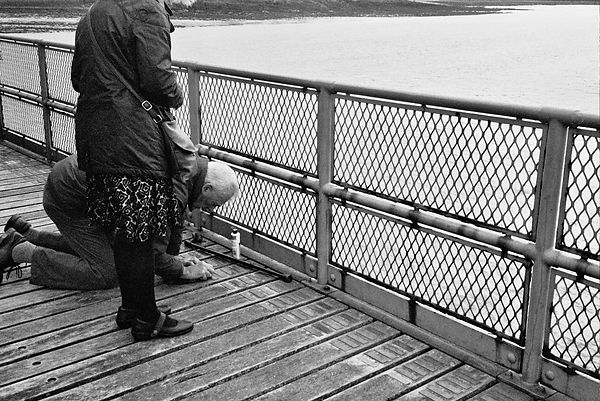
Without context, this image might be just an old guy that is cleaning something on the floor, with either their sister or wife or even friend standing there on some decking.
But I know as I was taking this photo, they were cleaning a brass plaque that had a name of a friend/family that had past away. The date also showed how long the person was alive and how old they were when they passed.
Rollei 35S, 40mm f2.8 - Taken By Ian Dafilmoto
Types of Lenses and How they Affect the Image
There are many different types of lenses that a photographer can use. The focal length of a given lens is defined as how far the glass elements are from the digital sensor or the film which is exposed on. Lenses typically have blades that stop light from coming in. These are called aperture blades and this is used to sharpen up the background blur. Background blur is also known as bokeh and will depend on how the photographer wants to use this in their image. But stopping down a lens (or reducing the amount of light in a lens) will introduce issues such as not having enough light in the lens. This is where ISO and shutter speed comes in. But the main focus will be on lenses, which can be compared below;
Zoom Lenses
The zoom lens can be very versatile and can be used in multiple scenarios in which the photographer finds themselves in. The best cases of these lenses are when you want one lens for your shoot and do not want to carry many lenses around with you.
One thing about these lenses is that the aperture does not open as wide as fixed focal length lenses. This might not enable the photographer to get enough light in nighttime scenarios when the photographer wants to hold the camera or for a more creative outcome, to get the best bokeh for the image. The photos show the different focal lengths achieved using one lens I own.
5 Reasons Why Zoom Lenses Are Better Than Primes (2022)


Sony A7 Mark II, 24-240mm, f3.5-6.3, Auto ISO
As you can see from the images, the photos are a little grainy due to needing to boost the ISO up as this can minimise camera shake and means I can shoot at a pretty fast shutter speed as well. Shooting with a tripod and a slower shutter speed can minimise noise and reduce hand shake as well.
Fixed Focal Length Lenses
This type of lens has a fixed focal length. This means that the photographer will not be able to zoom into a subject or details compared to a zoom lens. This might limit the framing of the subject and in the case of digital photos, lower the resolution of an image due to cropping the frame of an image.
But these lenses are best used when the photographer wants a lot of bokeh and wants to implement that usage in their image. This is achieved by opening up the lens and letting more light in. The caveat of this also means that a lower ISO and faster shutter speed can be used when shooting.
The most typical focal length of a fixed lens is 50mm (or otherwise called the nifty fifty) due to being the focal length that the human eye is typically rated at.
5 Reasons Why Prime Lenses Are Better Than Zooms (2022)
The image shown was shot on a Yashica T3 film camera. Due to the nature of automatic film cameras, the shutter speed and the aperture is not able to be shown. The lens is a fixed lens at 35mm, which is a lens that is wider than the human eye.

Yashica T3, Fixed 35mm 2.8 Carl Zeiss T*lens - shot on Portra 400
Wide Angle and Fish Eye Lenses
This type of lens goes beyond what the typical human eye focal length is and expands it further. These lengths are typically shorter than 50mm and could fit a wide point of view for the photographer. These are usually used for creative reasons or for photographic needs. These lenses elongate anything at the edges. This is usually called pincushion distortion and is sometimes unwanted for the photographer due to looking unnatural.
Fish eye lenses take this to an extreme and try and fit everything that the photographer can see within a scene and fits it into the image. These usually are seen with a black background with the scene in the middle, in a circle.
Wide-angle lens (2022)