Dry Point Prints - 07.10.22
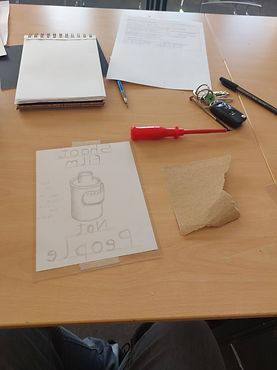
For this session, we had to do a dry point print using a clear plastic that we had to scratch at the surface with. I had come up with a print that was using lettering and had to be very careful with it, as any lettering that was not backward will end up as backward on the final print. It started out as a basic pencil drawing but turned into a dry point etching which was based on the drawing that I had done for the print. The drawing on the plastic can be seen below.
With the plastic print backing, it is very easy to see if there were any lettering mistakes, as this would show itself as being backward on the screen. In the other photo shots how I drew the design backward on paper and then traced it using a sharp point and some cross-hatching to give it some shading. I also scratched some lines on the plastic to get some textures onto the print.

Drypoint etching is a type of intaglio, which deforms the material that the ink is sat on. There are also different types of printmaking that you can do as well, which ranges from Relief printmaking to to stenciling. These are outlined below in the 4 basic categories that you can have.
Different Types of Prints
There are many different types of printmaking that one can do. Some basic categories are outlined below.
Relief Printmaking
With Relief printmaking, the ink sits ON TOP of the surface of a plate (or a block that has been carved with the design on. Some processes that have this type of printmaking are Wood Cut and Lino Cut.
Intaglio Printmaking
With Intaglio, the ink sits INSIDE little grooves that a sharp/blunt point has created on the medium. Different mediums include paperboard, plastic, and metal plates. Some examples of intaglio printmaking are etching, which uses acid to cut into the material, drypoint, which uses sharp/blunt objects to indent a plate and collagraph, which uses paperboard.
Planographic Printmaking
Planographic Printmaking prints from a flat surface instead of a groove which is the complete opposite to Intaglio printmaking. Some examples of planographic printmaking are Lithography, which is based on the idea that different substances are different in densities and thus are able to create the print by this offset. Another type of planographic printmaking is offset lithography, which uses another surface to print which is then transferred onto the final print. The last example of this method is mono printing, which is just a trace of an image from a photo straight onto the back of the print.
Stencil Printmaking
Stencil printmaking uses a medium (e.g. acetate or a chemical solution to BLOCK SELECTED AREAS on ink from a transferring surface. Examples of this are hand-cut stencils, which use an ink-repellant material that has been cut with the design to block out and ink certain areas. The other example is screen printing, which uses a meshlike material that can transfer and block out areas of ink within the screen so that ink can be transferred onto a printable material such as t-shirts and jumpers.