Saul Bass and Books Research - 01.02.24
I was going through the illustrations and typography experiments yesterday and it reminded me of a graphic designer/film-maker called Saul Bass and I wanted to go and explore what he created and use that as inspiration. I tried to look for a specific book that was all about his designs for both posters and films and I hoped that I could find it in the library.
But during this time, I also wanted to see what the art library had to offer and thus, I got a bit sidetracked and found some other things that have inspired me for my part of the magazine.
The photos shown below are the research that I have found, which used a combination of books and internet resources as I could not find a book in the library for Saul Bass. But by using the internet, I have found a website that sells originals of the posters and I think that this is enough to get some inspiration from.


Bunny Lake is Missing Poster - Saul Bass - 1965
Here is the Bunny Lake Is Missing Poster;
For this poster, the use of colour is very minimal as at the time when this poster was created, that would add a lot of cost to the creation of many posters and thus, the minimal use of colour.
The cutout shows a child, which signifies that the child might be the person missing from the movie and that this, could be either shot from the perspective of the mother (as shown by the way that a woman is shown through the child) or from a bit more detective work, from the police point of view. Either way, the name of the movie indicates that someone is missing and could be based on trying to find someone. I like the way that the mother is the one that is being presented in the cutout as this could show that she is the main subject for this movie and how her child has managed to disappear from her life.
There have been movies where the name of the movie does not fully correlate to the making of the poster and thus, this could be the case with this poster for the movie as well.
I also like the small detail that the person is shown on the pocket watch as this signifies the amount of time that the child has. The child also looks like it is hanging from the top of the pocket watch and looks like they are in danger.
The way that the stopwatch is shown as being open compared to what the sentence contradicts itself with the way that no one is opening up about the information, whilst the stopwatch is open.
I also like the way that the ending letters for missing fades into the background, which is how missing people normally are when they have been missing for a while and how hope for the missing person fades after they have been missing for a while as well.
The only bit of colour that was used for this poster is the red writing. The red writing could signify that a murder could be the cause of this film and thus, is written in red as blood could have been spilt onto the floor.
The recommended sign does date the poster a little bit as this is not what you would usually see for the poster of today. But remove that, then I personally think that you could have a timeless design for this poster.
Chromasaturation - Carlos Cruz-Diez - 2010
Another thing that I liked the look of from today’s research was “Chromosaturation” by Carlos Cruz-Diez, which comes from a book called Light. This book mainly focuses on art installations that use different lights to create some of these installations.
For this installation, it looks like Cruz-Diez has managed to use different light intensities and hues to create an installation that plays around the idea of Chromo (which is the word for colour or a pigment) and saturation (which is how intense this light is). I liked the way that image protrays how intense the colours are in the art installation and I think that using this for the project would be a cool thing to do.
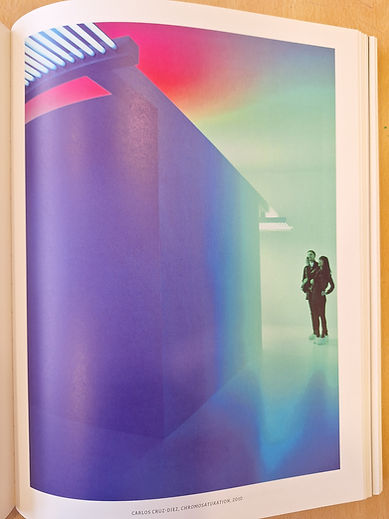
By combining these lights, the visitors can walk around and experience how light can be used to create something spectacular and rarely seen in everyday life, as we normally just see natural colours which are not intense at all compared to this art installation.
For me, a photo of this installation might not be enough to justify the feelings that I can get through a book. But, at least I can take some inspiration from this and use it for my magazine section.
I think portraying mental health as colours could be something that I play around with for my section of the magazine. Things that can relate to depression could be the colour blue, which either has a darkness to it by adding black to it to make it a darker tone, whilst could also desaturate it as well.
Performance - Carlos Cruz-Diez - 2011
The last one that I will be talking about for this research section of the project is called “Performance Chromatiques” By Carlos Cruz-Diez.

The thing that enticed me to take inspiration from this is the way that the background shows silhouettes of the dancers. Having such a stark contrast with the multicoloured lights and the people there makes for such an interesting texture within the background and the foreground of the photo. Due to it being a photo instead of an actual video, this might have a different effect on the installation or performance of the piece, but I can still take inspiration from the piece itself.
The colours used for the light look like they are the RGB variety and by adding them together, you get the whites that the most modern LED screens get and lead your eyes towards the back of the people dancing, their silhouettes being more prominent within the photo instead of the people in front due to the stark difference of the whites and blacks of the light and the shadows.
Actually, due to the processing of the colours in the book, I am not too sure about the colours of the lights, but it is safe to assume that mixing the red, green and blue lights, can transform the rays of light to be more white compared to the just mixing either one of the colours used for the lights.
The silhouettes also are not as detailed as people might have them to be as this might distract the viewers of the experience more with how each of them has different details rather than with how each person is moving within the performance. I think that not having this as a video really hinders the impact of the performance compared to having it as a photo as you cannot follow the movement of each person and see how the shadows potray the actions of the people in front.